FR
EN
Confirm order
LOG IN
Forgot your password ?
Identification
You can also use the following identification providers
New user? Create an account
Demo
Subscribe
Briefs
News
All articles
Sector
3 questions to...
Authorities
Congresses
Jurisprudence
Publications
Agenda
Regulation
All articles
European Commission
SCCS
ECHA
France
IFRA
International
Focus
The checklists
Trends
All articles
Ecoresponsibility
Market
Tech / Digital
Consumers
Experts
The checklists
Ingredients
All articles
News
Ingredients search
Ingredients by categories
Products
All articles
Products news
Launches trends
Recalls of products
Pack
All articles
News
Ecoresponsability
Innovation
Basics
All articles
Dossiers
Advising consumers
The language of labels
Cosmetics glossary
E‑Library
Confirm order
Articles
…
Ingredients
All articles
News
Ingredients
:
News
Phytonadione epoxide: preliminary Opinion of the SCCS
In June 2026, the SCCS (Scientific Committee on Consumer Safety) accepted the European Commission’s mandate to assess the safety of phytonadione epoxide. The Scientific Committee on Consumer Safety has just published its preliminary opinion.
CLH classifications: Intention for Terpineol, proposal for Capric acid
On November 4, 2026, ECHA (the European Chemicals Agency) announced that terpineol was the subject of a harmonized classification and labeling (CLH) intention and that capric acid was the subject of a classification proposal.
Reminder - IFRA 52: entry into force of the Specification and Restriction Standards
On 12 December 2025, the IFRA (International Fragrance Association) published the 52nd amendment to its Standards. Eleven months later, on 12 November 2026, the new Standards on specifications and restrictions came into force for new creations.
California targets three new PFAS under Proposition 65
On 30 October 2026, the California Office of Environmental Health Hazard Assessment (OEHHA) published three notices of intent to list certain chemicals – PFAS – under Proposition 65. The consultation period is open until 30 November.
Alternatives to microbeads: an analysis by the RIVM
They have been banned since 2023. But in products where they were useful, they had to be replaced with something else. Are the alternatives to plastic microbeads safe for human health and the environment? That is the question the RIVM sought to answer in this analysis.
Tuesday, March 9, 2021
Copper (nano) and Colloidal Copper (nano) : Final Opinion of the SCCS
The SCCS has just published its final Opinion on the safety of two cosmetic ingredients in the form of nanomaterials: Copper and Colloidal copper. It ...
Monday, March 8, 2021
Nano-TiO2: French ANSES recommends occupational exposure limit values
With 17,000 tonnes produced or imported each year in France, titanium dioxide in nanoparticulate form (TiO2-NP) is one of the nanomaterials most used ...
Monday, March 8, 2021
Ectoin® natural by bitop: at the heart of current trends
The demand for 100% natural, highly effective, safe and multi-functional active ingredients is growing rapidly. But there are only a very limited numb...
Monday, March 8, 2021
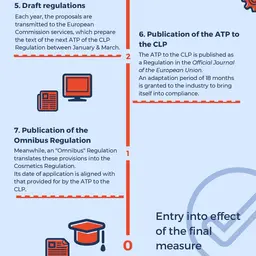
The timetable for a CMR classification in Europe
When a substance is classified as CMR, it is a priori prohibited for use in cosmetic products, unless an exceptional exemption is granted after evalua...
Monday, March 1, 2021
Nanomaterials in cosmetics: the French DGCCRF takes stock of the situation
The DGCCRF has been carrying out controls on nanomaterials in cosmetic products since 2017. In 2019, controls were intensified and focused both on the...
Monday, March 1, 2021
Microbiota and skin care: Givaudan's strategies
Whether it is a question of protecting it, balancing it or even using it to create cosmetic care products and respond to skin problems, such as skin s...
Monday, March 1, 2021
SantEnergy by Mibelle: energizing hair follicles
SantEnergy, the latest cosmetic active ingredient from the Swiss group Mibelle Biochemistry, is a polyphenol-rich extract sustainably obtained from th...
Monday, February 22, 2021
Endocrine disruptors: 2nd call for data from the European Commission
The European Commission is continuing its process of assessing the safety of potential endocrine disruptors used in cosmetic products. On 15 February ...
Monday, February 22, 2021
Threshold for the warning "Contains formaldehyde": request for the SCCS Opinion
At what concentration in the finished product must the warning “Contains formaldehyde” appear on the label of a cosmetic? The regulation currently set...
Monday, February 22, 2021
Fermentation by Biosyntia: for more sustainable cosmetic active ingredients
Naturalness and sustainability have become almost obligatory in order to meet growing consumer demand. However, sourcing sustainable raw materials is ...
Monday, February 15, 2021
CLH proposals for Hexyl salicylate and Disperse Red 17
The European Chemicals Agency (ECHA) has just launched two consultations on proposals for harmonised classification and labelling. One concerns Hexyl ...
Monday, February 8, 2021
HyRetin by Contipro: the new anti-ageing anti-acne treatment
It combines the biological effects of low molecular weight hyaluronic acid and retinoids. This new ester developed by Contipro, with very good skin pe...
Previous page
Next page
Please enable JavaScript to continue using this application.