FR
EN
Confirm order
LOG IN
Forgot your password ?
Identification
You can also use the following identification providers
New user? Create an account
Demo
Subscribe
Briefs
News
All articles
Sector
3 questions to...
Authorities
Congresses
Jurisprudence
Publications
Agenda
Regulation
All articles
European Commission
SCCS
ECHA
France
IFRA
International
Focus
The checklists
Trends
All articles
Ecoresponsibility
Market
Tech / Digital
Consumers
Experts
The checklists
Ingredients
All articles
News
Ingredients search
Ingredients by categories
Products
All articles
Products news
Launches trends
Recalls of products
Pack
All articles
News
Ecoresponsability
Innovation
Basics
All articles
Dossiers
Advising consumers
The language of labels
Cosmetics glossary
E‑Library
Confirm order
Articles
…
News
All articles
Sector
3 questions to...
Authorities
Congresses
Jurisprudence
Publications
Agenda
News
:
Authorities
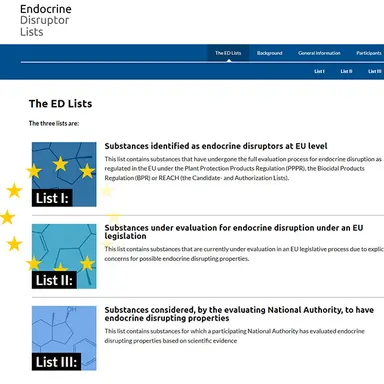
1st update of ED Lists for 2026
Since 2020, the “Endocrine Disruptor Lists” website, drawn up and updated twice a year by five national authorities from European Union Member States, has been listing substances proven or suspected to act as endocrine disruptors. The latest update was published this April 2026.
Excessive cadmium exposure: Cosmetics account for... very little indeed
In a report whose findings were published on March 25, 2026, ANSES confirms that the French population is overexposed to cadmium, a trace metal classified as carcinogenic, mutagenic, and toxic to reproduction. The result: while diet is the primary source of exposure, cosmetics also play a role—albeit a minor one—in consumer exposure.
PIFs for small cosmetics companies: 4 out of 5 are incomplete
During an investigation targeting very small businesses in the French cosmetics sector, the DGCCRF noted an overall insufficient level of knowledge and understanding of regulatory provisions among these small operators new to the market, emphasizing that they are, by definition, at higher risk of non-compliance and ignorance of regulations.
The issues surrounding a classification of sodium fluoride
On 18 December 2025, the French ANSES published an article on its website explaining the reasons that led it to propose a CLH classification of sodium fluoride as ED HH 1 and Repr. 1B. The information was widely reported in the mainstream media, prompting FEBEA to issue a clarification.
2nd update of ED Lists for 2025
Since 2020, the “Endocrine Disruptor Lists” website, drawn up and updated twice a year by five national authorities from European Union Member States, has been listing substances proven or suspected to act as endocrine disruptors. The latest update was published this December 2025.
Tuesday, May 1, 2012
Bye-bye Afssaps, welcome ANSM
A new entity, the French National Agency for the safety of medicine, health products and cosmetics (ANSM) replaces the French Agency for the safety of...
Sunday, April 8, 2012
Ethylhexyl Methoxycinnamate: safe for use, says Afssaps
Widely used in sunscreens, in daily anti-ageing cares with SPF, but also in lip’s balms, shower-gels and body care oils, Ethylhexyl Methoxycinnamate, ...
Tuesday, March 13, 2012
Essential oils: labels with incomplete information
The French Commission of Consumers Safety (CSC, as per its French acronym), an independent administrative authority comprising magistrates, profession...
Friday, February 17, 2012
Quassin on the verge to be banned?
Extracted from the quassia tree (also called Bitter tree) bark (Quassia amara L.) or from Picrasma excelsa, quassin has recently been evaluated by the...
Wednesday, February 1, 2012
Revitalift: banned ad
We know our UK friends are far more stringent than any other European advertising standards authority for the accuracy of ads, especially those dealin...
Tuesday, December 6, 2011
GMP: Advice from the French Afssaps
During the Congress on Perfumes & Cosmetics, held in Chartres on November 23 and 24, 2011, the French Agency for the sanitary safety of health pro...
Tuesday, December 6, 2011
Teeth whitening: sanitary authorities warning
It is trendy to have pristine-enameled white teeth. The success experienced by the new concept, the "Smile Bars", comes as a proof. A "Smile Bar?" Thi...
Tuesday, November 22, 2011
Formaldehyde, in a more severe carcinogenic category?
Formaldehyde is used as a biocide, a preservative and a fixing agent, in many consumer goods and construction products … and also, on a small scale, i...
Thursday, November 17, 2011
Aluminum in cosmetics dangerous to health (Afssaps)
The potential toxicity of aluminum in cosmetics has been a concern for several years. Often accused of promoting breast cancer or Alzheimer’s disease,...
Wednesday, November 16, 2011
Beware of the risks due to skin depigmentation!
The French Afssaps launches an awareness campaign about the health risks linked to "the voluntary practice of skin depigmentation". This shall be unde...
Tuesday, August 30, 2011
An endocrine disruptor, 3-Benzylidene-Camphor, banned in cosmetics in France
The French Agency Afssaps has decided, on August 24, to ban this product. Considering that this UV filter is able "to disrupt endocrine functions and ...
Wednesday, August 24, 2011
Cosmetovigilance: the 2010 figures of undesirable effects due to cosmetics
As it does every year, the French Agency for the safety of sanitary products (Afssaps) has just released its Cosmetovigilance data for 2010. Still hig...
Previous page
Next page
Please enable JavaScript to continue using this application.