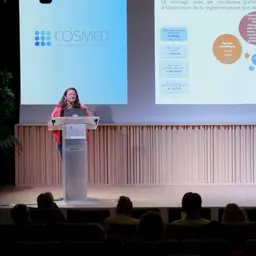
In the age of layering and skincare routines, products are no longer used alone but in combination—one on top of the other—which increases the number of points of contact, the potential for incompatibilities between the skin and the products or between the products themselves, and the risk of unwanted flaking… At the Cosmed scientific conference held on September 29, 2026, Muriel Morelli, founder and CEO of Muriel Morelli Sciences and Cosmetics, shared the keys to preventing this.
“Let me say this right off the bat: there’s no such thing as a miracle solution,” Muriel Morelli began. “My presentation will focus instead on understanding the key mechanisms, identifying risk factors, and seeing how we can anticipate them in product formulation.”
Today, a cosmetic product is most often part of a routine (cleanser, serum, day cream, sunscreen, etc.), which makes it not a standalone product, but a layer of product that is applied between other layers.
This can cause fuzz or lint to appear when applied to the skin.
The phenomenon of flaking
Flaking refers to the appearance of solid clumps or aggregates on the surface of the skin, following mechanical stress or shearing, which occurs naturally when a cosmetic product is applied or when the user touches the area where it has been applied.
This phenomenon has nothing to do with formula instability, but it does affect the product’s sensory properties and, consequently, the consumer’s overall satisfaction.
Interfaces and interactions
To understand how pilling occurs, we must first identify the interactions that take place at the two main interfaces where incompatibilities arise:
• the skin-product interface, where the skin is not inert and varies from …