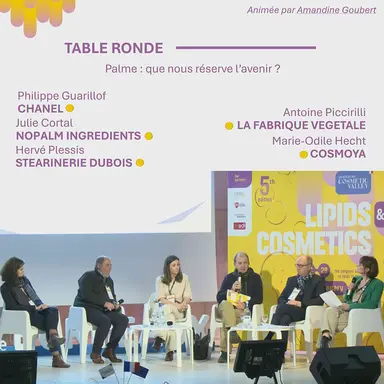
During the 5th edition of the Lipids & Cosmetics Congress, held on January 28 and 29, 2026, a round table discussion was organized on the theme “Palm oil: what does the future hold?” Hervé Plessis, CEO of Stéarinerie Dubois, Philippe Guariloff of Chanel, Julie Cortal of Nopalm Ingredients, Antoine Piccirilli, Scientific Director of La Fabrique Végétale, and Marie-Odile Hecht, Director of Cosmoya, outlined possible answers to this question.
Before addressing the issues surrounding this topic, Hervé Plessis reviewed some facts about the palm oil industry and the role played by the cosmetics sector.
Production
“Palm oil is an exotic oil,” he began.
Oil palms are grown on a very small strip of land between the Tropic of Cancer and the Equator, and for historical reasons, 85% of oil production comes from two countries: Indonesia and Malaysia. A total of 24 million hectares are planted, producing 90 million tons of oil each year, 40% of which is produced by five million smallholders on family farms.
It is the world’s leading oil crop, accounting for 39% of total oil production, while using only 7% of the land devoted to oilseed cultivation. In comparison, soybeans, which account for 27% of total oil production, use 61% of this land.
This is due to its exceptional yield of 3.5 tons of oil per hectare, compared to 0.42 for soybeans, 0.76 for rapeseed, and 0.70 for sunflowers.
Another unique feature is its composition, as it is particularly rich in fatty acids, especially in the C8, C10, and above all C12 fractions, which no other oil can match, especially those that …