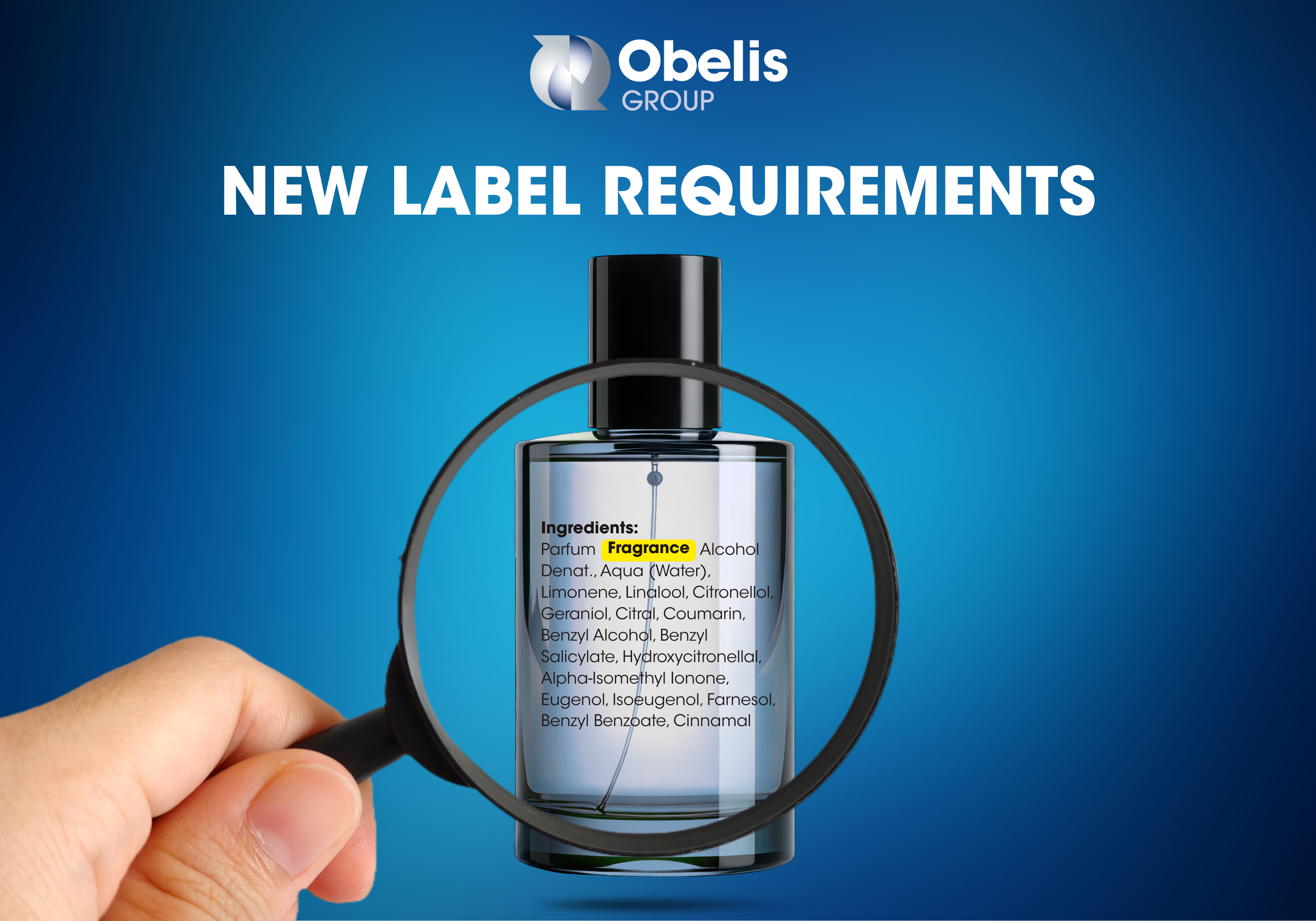
On 31 July 2026, a new European Union regulatory requirement affecting the majority of cosmetic products will become applicable. By this date, beauty brands placing products on the EU market must ensure that their labels include the disclosure of 56 additional fragrance allergens in the ingredient list. Through this amendment to the EU Cosmetics Regulation, the total list has expanded from 26 to 82 allergens.
As your Responsible Person, Obelis is ready to support you throughout this transition and ensure your products remain fully compliant.
Allergen Disclosure as a Tool for Consumer Safety
In recent decades, consumer safety has received increasing attention, with individuals becoming more mindful of the products they use and demanding greater transparency from brands. These expectations – spanning a wide range of products, including cosmetics – have been addressed at the regulatory level, with the European Union leading the way in promoting consumer safety and transparency.
The strict labeling requirements for cosmetic products – designed to support informed consumer choices – fit squarely within this context. Among the information that must be disclosed on labels at the European level, as well as in other jurisdictions, are fragrance allergens, which aim to provide a higher level of consumer protection.
Fragrance allergens: definition and regulatory evolution in the European Union
Fragrance allergens are chemical substances found in fragrance ingredients which, upon repeated exposure through the use of cosmetic products, may lead to contact allergies. These reactions can manifest in various forms, including dermatitis, eczema, and skin irritation.
Fragrance ingredients are widely used in perfumes and other scented cosmetic products, but also in detergents and fabric softeners. They may be of either synthetic or natural origin.
To help sensitised individuals avoid exposure to substances to which they are allergic, the European Commission, in 1999, mandated the Scientific Committee on Cosmetic Products and Non-Food Products Intended for Consumers (SCCNFP) – now known as the Scientific Committee on Consumer Safety (SCCS) – to identify the main fragrance allergens present in cosmetic ingredients.
This initial assessment identified 26 fragrance allergens, which remained the substances required to be declared on product labels until 2026.
However, in 2011, the SCCS issued a further opinion identifying additional allergens of relevance for consumer protection.
It took the European Commission 12 years to incorporate these newly identified substances into the Cosmetics Regulation. In July 2023, Commission Regulation (EU) 2023/1545 introduced 56 additional fragrance allergens that must be individually declared on cosmetic product labels.
With this amendment to the EU Cosmetics Regulation, the total number of listed allergens has increased from 26 to 82.
European Union: compliance deadlines
The deadlines for updating cosmetic product labels’ ingredient lists to include the newly regulated fragrance allergens are as follows:
• 31 July 2026 for new cosmetic products placed on the EU market
• 31 July 2028 for cosmetic products already on the EU market.
Many brands risk missing at least one of the key Cosmetics 2026 regulatory deadlines.
Need a clear overview of the deadlines taking effect in the first quarter of 2026? Explore our 2026 Timetable for Cosmetics Businesses.
United Kingdom: from alignment to diverging requirements
Following the United Kingdom’s withdrawal from the European Union and the end of the transition period on 31 December 2020, the UK retained the EU Cosmetics Regulation within its domestic framework. However, divergences have since begun to emerge, partly due to delays in incorporating EU updates into the UK regulatory system.
Want a deeper breakdown of the post-Brexit differences?
Read our article for practical insights.
One notable example is that the United Kingdom has not yet incorporated the additional 56 fragrance allergens into its Annex III. As a result, products that may be non-compliant in the EU could still be compliant in the UK, provided they meet the specific UK requirements (such as the appointment of a Great Britain Responsible Person).
It is important to be aware of these regional nuances, as they can be easily overlooked. Obelis experts support brands in adapting their labels to meet global label requirements, ensuring smooth market access everywhere.
Simplify Your Strategy → Get in touch now.

Canada and the United States: fragrance allergen requirements
In October 2024, Canada amended its Cosmetic Regulations, introducing additional requirements that further align its regulatory framework with that of the European Union. Key changes include new obligations for fragrance allergen labeling and product notification disclosures. Notably, Canada directly references Annex III of the EU Cosmetics Regulation, requiring beauty brands to disclose all 82 EU-regulated fragrance allergens on product labels. These requirements are being phased in across a set of three deadlines running from April 2026 to April 2027.
In contrast, the United States does not yet have a specific regulatory framework governing fragrance allergens. The Modernization of Cosmetics Regulation Act of 2022 (MoCRA), which significantly changed the US cosmetics regulatory landscape, mandates the FDA to develop a dedicated regulation addressing fragrance allergens. Although the industry expected a proposal in 2024, it has been delayed. It remains uncertain whether the FDA will adopt the same list of allergens as the EU.
Recommendations for Beauty Brands to ensure compliance
The first step toward compliance is to identify affected products. All cosmetic products containing fragrance ingredients – such as perfumes, essential oils, and even natural extracts – may be impacted.
Brands should then contact their fragrance suppliers to obtain updated documentation and assess whether any of the newly identified 56 fragrance allergens exceed the applicable thresholds and must therefore be declared on product labels.
The next steps involve amending ingredient lists on product labels and updating the CPNP notifications accordingly to reflect the new artworks.
Failure to comply may result in products being held at customs or denied entry to the EU market. If labels have already been printed, solutions may still be available.
It is also advisable for brands operating in the United Kingdom and the United States to begin updating their ingredient lists to include the fragrance allergens newly regulated in the EU. This proactive approach not only anticipates potential future regulatory developments in these markets but also helps ensure that consumers are properly informed about the products they use, therefore supporting a high level of product safety.
Obelis has supported 7,000+ manufacturers across 90+ countries in resolving such issues and helps beauty brands approach compliance with a global perspective, so your labels work in every market you serve.
About Obelis
Obelis Group is a leading regulatory and compliance consultancy based in Brussels, specializing in cosmetics, medical devices, and other regulated products. With over 35 years of experience, we help brands navigate complex EU, UK, US, Canadian, Swiss and Turkish regulations to achieve and maintain compliance. Our mission is to make market access faster, safer, and simpler.
Want to ensure your products are globally compliant?
Let’s talk!
References
• European Commission. (2023). Commission Regulation (EU) 2023/1545 of 26 July 2023 amending Regulation (EC) No 1223/2009 of the European Parliament and of the Council as regards labelling of fragrance allergens in cosmetic product. Retrieved on 08/04/2026.
• European Commission. (2022). Opinion on Fragrance allergens in cosmetic products. Retrieved on 08/04/2026.
• Government of Canada. (2025). Industry Guide for the labelling of cosmetics. Retrieved on 01/12/2025.
• Legislation.gov.uk. (2019). Regulation (EC) No 1223/2009 on Cosmetic Products, as amended by the Product Safety and Metrology etc. (Amendment etc.) (EU Exit). Retrieved on 08/04/2026.
• SCCS. (2011). Opinion on Fragrance allergens in cosmetic products. Retrieved on 08/04/2026.