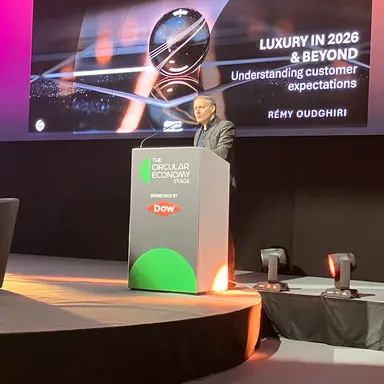
During Paris Packaging Week 2026, Rémy Oudghiri, CEO of Sociovision (Ifop Group), presented the results of an international study conducted in June 2025. The aim was to understand what motivates people to buy luxury products and experiences today, in an economic and societal context marked by uncertainty.
The survey was conducted among more than 4,500 luxury goods consumers in Europe, North America, and Asia.
Key findings
Despite market changes, the fundamental drivers of luxury goods purchases remain relatively constant.
The investment aspect remains important, particularly in an unstable geopolitical context. Luxury continues to be perceived as an “asset capable of standing the test of time and being passed on.”
The status aspect also continues to carry considerable weight. Luxury remains a tool for social affirmation and distinction. “In addition to these two historical pillars, there is a reward aspect, which has been reinforced in recent years. Luxury is becoming a way to restore confidence or take a break in high-pressure professional environments,” comments Rémy Oudghiri.
Finally, the escapism dimension remains central, with luxury playing an emotional refuge role in the face of contemporary tensions.
Different types of consumers
The study distinguishes five main profiles, now present in all geographical areas, with similar levels of representation.
Hedonists represent 23% of customers. For them, luxury is a one-off reward and a source of confidence.
Connoisseurs (19%) are focused on expertise, heritage, and lasting quality. They see luxury as an investment over time.
Creatives (22%) use luxury as a source of inspiration in their daily lives and as a means of personal expression.
Status seekers (18%) are primarily seeking social recognition and affirmation of their level of success.
Finally, dreamers (18%) see luxury as a means of escape and projection into a more positive future.
Product or experience?
Certain demographic groups remain very attached to products, which embody social status. Creative types, on the other hand, largely favor experiences, seeking instant gratification.
Each type has specific expectations. Hedonists favor experiences linked to immediate pleasure, particularly in tourism, gastronomy, and wellness.
Creative types seek experiences that nourish their identity and inspiration, with a marked interest in second-hand and vintage items.
Status-conscious individuals expect support, advice, and experiences from brands.
Connoisseurs favor access to product information, history, and expertise.
Dreamers seek novelty, discovery, and immersion in new worlds.
What challenges does the luxury industry face?
Rémy Oudghiri identifies three major challenges.
The first concerns the physical experience, which remains central despite digitalization. Consumers still expect human advice.
The second challenge is ethics. Most customers are now sensitive to environmental and societal issues.
Finally, artificial intelligence is emerging as a key lever in customer relations. The vast majority of luxury goods consumers already use it and consider it legitimate for brands to use it in their interactions.