Since its publication, Directive (EU) 2024/3019 concerning urban waste water treatment has been the subject of constant criticism from the cosmetics industry. The latest is based on a study estimating the costs of implementing quaternary treatments in France.
The new Urban Wastewater Treatment Directive provides for the introduction of a system of Extended Producer Responsibility (EPR), so that by 2027, manufacturers of pharmaceuticals and cosmetics will be required to pay for the installation, operation and monitoring of quaternary wastewater treatment systems in all member states.
The cosmetics and pharmaceuticals industries dispute not only the scientific basis on which the European Commission has attributed almost all micropollutant emissions to these two sectors alone, but also the amount of investment required, which has been grossly underestimated.
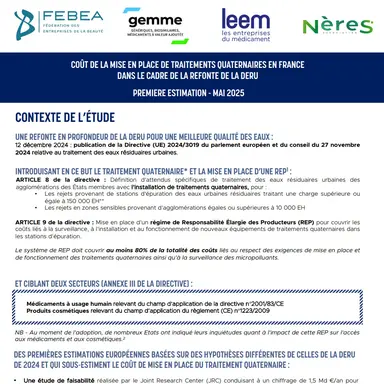
This is why four French federations have joined forces to study the impact of EPR on their industries. They are FEBEA (French Federation of the Cosmetics Industry), GEMME (Generic Drug Association), LEEM (Professional organization of pharmaceutical companies operating in France) and NèreS (Association representing pharmaceutical companies that produce and market primary care health and prevention products available in pharmacies without a prescription.). The aim was to produce an initial estimate of the costs of setting up and running quaternary treatments as provided for in the new version of the European Directive for France between 2028 and 2045.
“The results reveal that the upgrading of treatment plants to deal with micropollutants, as required …