Discover key cosmetic labeling requirements across the EU, US, and Canada. Learn why “one label fits all” is a costly compliance myth.
Creating a label for a beauty brand is often a delicate balancing act. It must harmonize marketing appeal, creative design, compelling yet palatable text, and strict regulatory requirements. Regulations dictate a significant portion of the information that must be included and often force marketing texts to be reshaped to meet compliance standards. When labels fail to meet mandatory requirements, they often need to be reprinted – an expensive and time-consuming process.
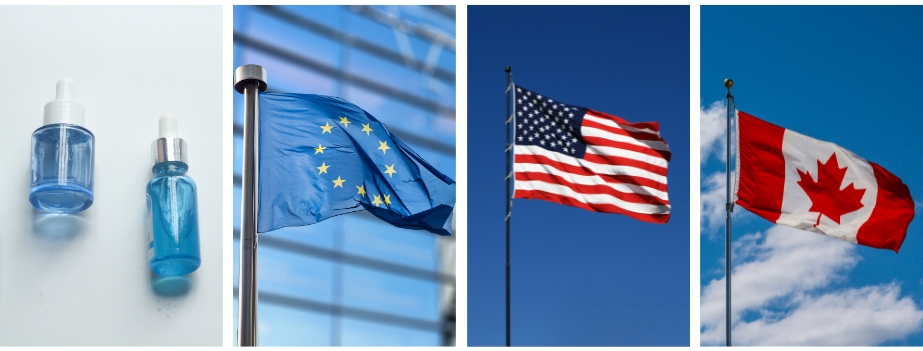
To make matters more complex, regulatory requirements vary by territory. In some cases, even different regions within the same country may impose distinct standards depending on where the product is marketed. Many assume that if a label complies with European Union regulations – considered among the most stringent – it will automatically be compliant everywhere. However, this is not always true. This disconnect can lead to confusion, frustration, and delays for beauty brands.
So, what exactly are these regulatory requirements, and how do they differ between territories?
Critical Regulatory Divergence: The EU-UK Compliance Challenge
In the European Union, Cosmetic Products Regulation (EC) No.1223/2009 – in force since July 11, 2013 – sets out binding rules for cosmetic labeling across all member states. Under Article 19, cosmetic labels must display, in indelible, visible, and legible lettering:
• Name and address of the Responsible Person (RP)
• Country of origin (if the product is manufactured outside the EU/EEA)
• Nominal content (weight or volume) in the metric system
• Shelf life and batch number
• Precautions for use, warnings, product function, and a complete ingredient list (in descending order by weight) using the INCI nomenclature
In addition to these requirements, marketing claims are strictly regulated – not only by the Cosmetics Regulation itself but also by a separate regulation focused specifically on the substantiation of cosmetic claims. The good news for brands is that these rules apply uniformly across the EU, and as long as the required information is accurately translated into each national language, compliance is achievable.
However, there is one important exception: recycling symbols. These are currently country-specific, and some member states – such as France, Italy, and Spain – impose their own distinct recycling logos or labeling requirements.
Many brands miss at least one of the EU’s mandatory elements. Need step-by-step instructions for compliant EU labels? Explore our EU Labelling Guidance for detailed requirements and examples.
Access our guide
As for the United Kingdom, following Brexit it has adopted the EU’s cosmetic product and claims regulations. While the UK is gradually diverging from the EU on matters such as ingredient safety, labeling requirements remain largely aligned, with one key difference: products marketed in Great Britain must designate a UK-based Responsible Person.
U.S. Labeling: One Law, Fifty Interpretations
At the federal level, cosmetic labeling is regulated primarily under the Food, Drug, and Cosmetic Act (FD&C Act) – recently amended in 2022 by the Modernization of Cosmetics Regulation Act (MoCRA) – and the Fair Packaging and Labeling Act (FPLA). Federal requirements include:
• Product identity, net quantity (in the imperial system), and the name and address of the Responsible Person
• Ingredient declaration using INCI names, with the exception of botanicals, which must be identified by their common names
• A clearly visible contact point for reporting adverse events
• Specific warning statements, such as for tanning products, mandated at the federal level only for certain ingredients or product types
However, the U.S. regulatory landscape is fragmented. While federal law establishes a national baseline, individual states are permitted to implement additional regulations, provided they offer a higher level of consumer protection. This results in a non-harmonized framework, not only regarding ingredient safety – which is for the most part exclusively governed by state laws – but also in terms of labeling requirements. Many states mandate additional warnings or information on cosmetic labels beyond federal requirements.
The Case of California
The Case of California, in particular, enforces some of the strictest state-level cosmetic regulations in the country:
• Proposition 65 requires businesses to provide clear warnings for cosmetics containing any of the listed chemicals known to cause cancer, birth defects, or other reproductive harm – such as formaldehyde or lead – unless the level of exposure falls below established safety thresholds
• The state’s Consumer Products Regulations also limit the use of volatile organic compounds (VOCs) in consumer products, including cosmetics. The permissible level of VOCs varies by product category, and those categories are determined largely by how a product is labeled and marketed. This means that poorly phrased claims or a poorly structured label may lead to misclassification – placing the product into a category with a much stricter VOC limit, which can render it non-compliant, even if the formula itself would be acceptable under another classification.
Two Languages, One Label: Canada’s Dual Demand
Cosmetics in Canada are regulated under the Cosmetic Regulations of the Food and Drugs Act, enforced by Health Canada. Labels must include the following information in both English and French:
• Product identity, net quantity (in metric units), full ingredient declaration using the INCI nomenclature, and the name and address of the dealer
• A digital contact point for consumer inquiries, accessible in both languages
• Any warnings or cautionary statements necessary for safe use
Need a practical roadmap? Obelis provides in-depth training materials to help your team navigate the Canadian Cosmetics Regulations. Watch the webinar
Beyond Bilingual: Quebec’s Language Laws for Labels
While federal regulations require that all mandatory information appear in both official languages, the province of Quebec imposes additional language rules under the Charter of the French Language. Specifically, French must be at least as prominent as English in every aspect of product presentation, including:
• Text size
• Font type and style
• Visibility and placement on the packaging
The recently enacted Bill 96, which amended the Charter, further extends these rules to trademarks. As a result, descriptive brand names that are not in French and not registered in Canada must now be translated into French to comply with Quebec’s labeling laws.
These regional nuances can easily be overlooked. Obelis experts support brands in adapting their labels to meet both broad and local requirements, ensuring smooth market access everywhere. Simplify Your Strategy
Why One Size Doesn’t Fit All in Labeling?
While beauty brands may attempt to create a single label that includes all mandatory information for every market they wish to enter, this is not always feasible. Labeling is rarely a one-size-fits-all exercise.
Labeling requirements have been gradually introduced by regulators to promote – among other things – consumer safety, transparency, and informed choice. Yet, many of these requirements also reflect cultural preferences, linguistic expectations, and consumer behavior unique to each region. For example, something as straightforward as net quantity must be expressed in different units depending on the country – imperial in the U.S., metric in Canada and the EU.
Even within regions that offer a harmonized baseline, such as the EU and UK, local nuances may persist. Translation rules vary, and several EU member states mandate bilingual or even trilingual labeling. Quebec’s Charter of the French Language goes further, aiming to protect the French language and ensure linguistic equality, so that French speakers in the province have the same user experience as English speakers elsewhere in Canada.
Learn more about how Obelis can help you with global compliance
In the United States, federal standards are layered with state-specific requirements particularly in California, which enforces its own rules with a focus on consumer health and environmental protection.
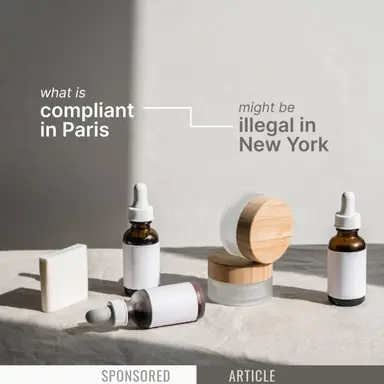
Ultimately, a label that passes regulatory review in Paris could be flagged in New York or California – not because the EU’s rules are less strict, but because each jurisdiction prioritizes different aspects of safety, language, and communication, and differences in requirements often reflect priorities rather than stringency.
One label may open doors in Paris but close them in New York. Obelis helps beauty brands see through a global compliance lens, so your labels work everywhere you sell.
Get in touch with our experts
About Obelis
Obelis Group is a leading regulatory and compliance consultancy based in Brussels, specializing in cosmetics, medical devices, and other regulated products. With over 35 years of experience, we help brands navigate complex EU, UK, US, and Canadian regulations to achieve and maintain compliance. Our mission is to make market access faster, safer, and simpler. Want to ensure your products are globally compliant? Let’s talk!
References:
• Canada Gazette (2025). Regulations Amending the Cosmetic Regulations (2024). Retrieved on 2 September 2025.
• Congress.gov. (2022). The Modernization of Cosmetics Regulation Act. Retrieved on 2 September 2025.
• EUR.lex (2009). Regulation (EC) No 1223/2009 of the European Parliament and of the Council on Cosmetic Products. Retrieved on 2 September 2025.
• Légis Québec. (2022). Charter of the French language. Retrieved on 2 September 2025.
• Legislation.gov.uk (2020). Product Safety and Metrology etc. (Amendment etc.) (EU Exit) Regulations 2019, Schedule 34: UK Retained Regulation (EC) No.1223/2009 on cosmetic products. Retrieved on 2 September 2025.