The organic health and beauty market is entering a new phase. The decline is slowing, new players are emerging, and certain channels are clearly faring well. This is the picture painted by Nicolas Grélaud, Director of OpenHealth, at the Cosmébio General Assembly, held in Paris on April 23, 2026.
Combined sales across the four channels (supermarkets, specialty organic stores, pharmacies, and drugstores) totaled 499 million euros as of the end of March 2026, down 7.7% year-over-year. But this average masks very different realities. “The overall trend is downward, but highly uneven,” summarizes Nicolas Grélaud. “And with some very interesting signs emerging.”
Supermarkets remain the leading channel with €190.6 million in revenue, accounting for one-third of sales, but they recorded the sharpest decline: -14.5%. This decline has been ongoing since 2022, when the market peaked at €291 million.
All categories are affected, from baby care to sun care. The 12% price premium compared to conventional products remains a major obstacle for consumers who do not always see what justifies this difference.
Pharmacies: the only growing channel
Pharmacies stand out as the only channel experiencing growth, with €128 million in revenue and a 3.9% increase. Between 2021 and 2025, the average annual growth rate for health and beauty products in pharmacies reached 8%, three times higher than before the COVID-19 pandemic.
“Pharmacies have a built-in captive customer base,” explains Nicolas Grélaud. “The scarcity of medical services will automatically strengthen the role of the local pharmacist. It’s a groundswell.”
Body care posted 13% growth as of the end of March 2026. The established brands (Weleda, Patyka, Jonzac) coexist with rapidly growing challengers such as Respire, MKL, and Dr. Hauschka.
A new trend is also emerging: “in & out”, at the intersection of beauty and nutrition.
Organic shops and parapharmacies: a slowdown in the decline
Specialty organic shops reported €137 million in revenue, a decline of 8.3%.
Only the sunscreen segment showed significant growth. Hair care remains a weak point, while organic makeup suffers from a lack of visible innovation on the shelves.
Mass retail drugstore segment, the smallest channel with €44 million in revenue and -3.8% growth, shows no notable movement.
Only the hygiene and body care segment is performing well, with nearly double-digit growth.
Leverage points for reinvention
Faced with this picture, Nicolas Grélaud identifies five avenues for organic stores:
• Rethinking the pricing structure between essential and expert product lines
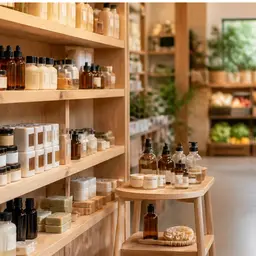
• Restructuring the aisles around evidence and benefits
• Focusing on health as a differentiator
• Simplifying and streamlining the product offering
• Activating the point of sale as a living space
“The organic health and beauty market is not a niche market,” he concludes. “It is an essential value proposition. We must now clearly explain what makes organic products valuable and make the purchasing process as seamless as possible for the consumer.”